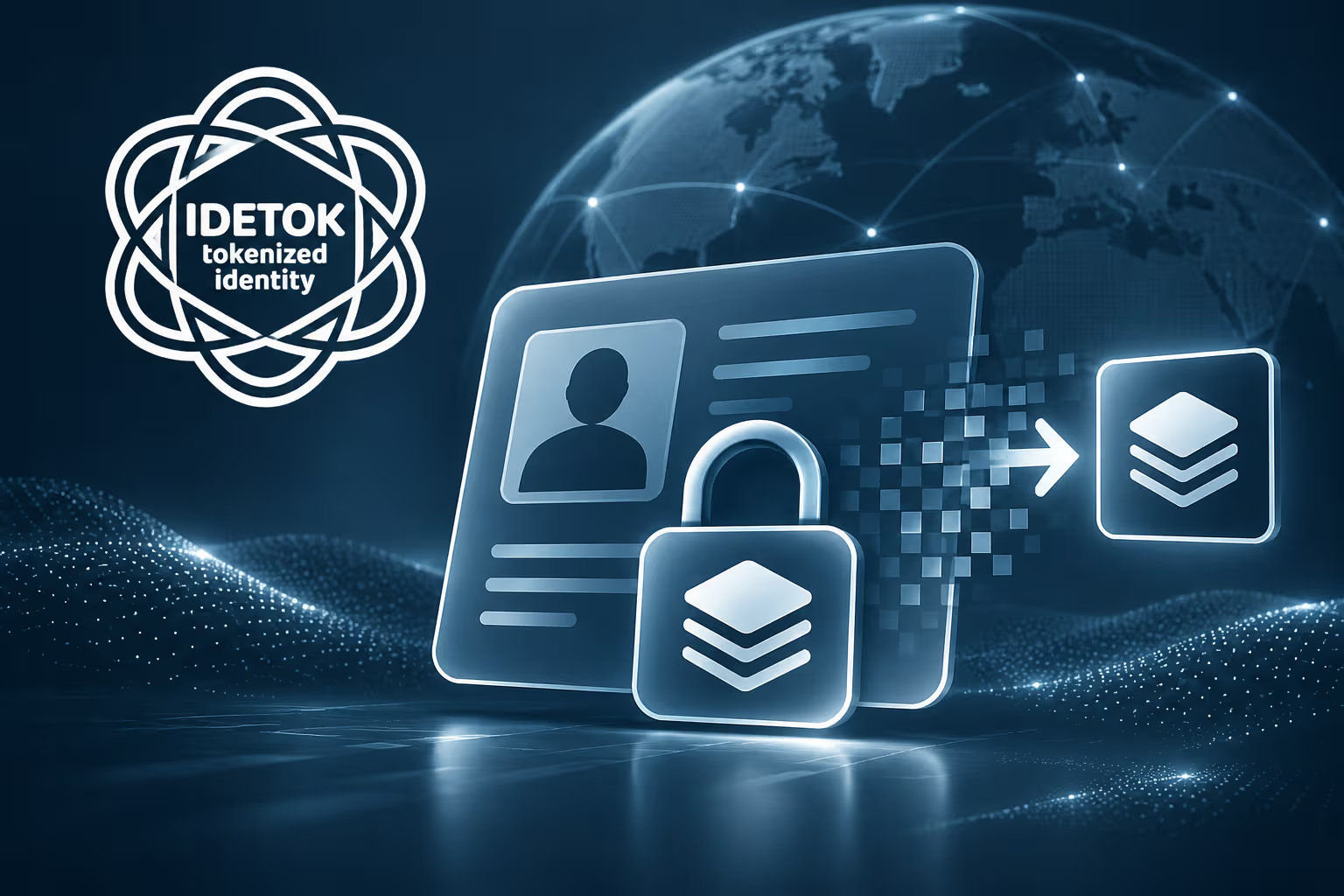
Discover how tokenization is transforming the future of digital identity by protecting sensitive personal information, strengthening authentication, and reducing the risks of data exposure. Explore how secure digital tokens, verifiable credentials, and privacy-preserving technologies enable individuals and organizations to verify identity without unnecessarily revealing personal data, building greater security, trust, and confidence in an increasingly connected digital economy.
A New Era of Digital Identity
Every digital interaction leaves a trace of personal information. From opening a bank account and accessing healthcare services to signing contracts and verifying age, individuals are repeatedly asked to share sensitive identity data.
Traditional identity systems often depend on collecting, storing, and transmitting personal information such as names, dates of birth, identification numbers, and addresses.
This approach creates significant privacy and security challenges. The more organizations that store sensitive identity information, the more potential targets exist for cybercriminals.
Tokenized identity offers a different approach: proving or referencing identity without repeatedly exposing the underlying personal data.
Instead of distributing sensitive information across multiple databases, tokenization can replace identifying data with digital tokens that serve a defined purpose within a secure system.
This concept is becoming increasingly relevant as financial services, digital government, artificial intelligence, and decentralized technologies reshape the global economy.
What Is Tokenized Identity?
Tokenized identity is an approach to digital identity management in which sensitive personal information or identity references are represented by substitute digital tokens.
A token is a generated value that can be used in place of an original identifier within a particular system or transaction.
For example, rather than storing an individual's national identification number in multiple applications, an organization can use a token connected to that information in a protected environment.
The token itself does not need to reveal the original personal information.
However, tokenization is not automatically anonymization. A token may still be considered personal data when it can be linked to an identifiable individual.
The security of the system depends on how tokens are generated, stored, validated, exchanged, and controlled.
How Tokenized Identity Works
A typical tokenized identity architecture involves several stages.
1. Identity Verification
An individual establishes their identity through an authorized identity provider or verification process.
Depending on the required assurance level, verification may involve government-issued documents, cryptographic credentials, or other trusted evidence.
2. Token Generation
After verification, the system generates a digital token or tokenized reference.
This token can represent an identity record, a particular attribute, or an authorization within a defined application.
3. Secure Data Storage
Sensitive underlying information remains protected within an identity management environment.
When a token vault is used, it maintains the association between the token and its underlying data under strict access controls.
4. Identity-Based Transactions
When an individual accesses a service, the receiving organization can use the token to retrieve authorized information or request verification.
The organization does not necessarily need direct access to the original identification data.
5. Validation and Access Control
The identity infrastructure validates the token and determines whether the requested operation is permitted.
Tokens can be designed with limited scope, expiration periods, and revocation mechanisms.
The result is an identity architecture that can reduce unnecessary exposure of sensitive information.
Tokenization vs. Encryption
Although tokenization and encryption are both used to protect information, they operate differently.
Encryption transforms readable information into ciphertext using a cryptographic algorithm and key. Authorized parties can restore the original information through decryption.
Tokenization substitutes sensitive information with another value, often generated independently of the original data. In vault-based systems, the original information is retrieved through a protected mapping.
The distinction matters because a properly designed token does not need to contain enough information to reconstruct the original value.
However, both approaches require secure infrastructure, strong access controls, and ongoing risk management.
In many real-world identity systems, tokenization and encryption work together.
Why Tokenized Identity Matters
Stronger Personal Data Protection
Tokenization can reduce the exposure of sensitive identifiers across interconnected systems.
If a database containing tokens is compromised, attackers may obtain less directly useful information than they would from a database containing original identity records.
The actual protection depends on whether the tokens can be linked to other information or used outside their intended context.
Reduced Data Collection
Organizations can design identity processes around collecting only the information necessary for a particular service.
For example, a digital platform may need to establish that a user meets a minimum age requirement without receiving the user's full date of birth.
This principle is known as data minimization.
More Efficient Digital Verification
Reusable identity infrastructure can reduce the need for individuals to submit identification documents repeatedly.
When supported by secure identity providers and appropriate standards, verification can become faster and more consistent.
Greater User Control
Advanced digital identity architectures can allow individuals to control which identity attributes they disclose and to whom.
This is particularly relevant to systems built around digital wallets and verifiable credentials.
Tokenized Identity and Verifiable Credentials
Tokenization is one component of a broader transformation in digital identity.
Another important technology is the Verifiable Credential (VC).
A verifiable credential is a digitally expressed claim issued by a trusted party, such as a university, financial institution, or government authority.
Cryptographic mechanisms can allow another party to check its authenticity and integrity.
For example, a university could issue a digitally verifiable qualification that a graduate presents to an employer.
The employer may be able to validate the credential without independently contacting the university during every verification.
Some credential systems support selective disclosure, allowing users to reveal only particular attributes.
More advanced cryptographic methods, including zero-knowledge proofs, can support verification of certain statements without revealing all underlying data.
Importantly, a verifiable credential is not necessarily a tokenized identity. The technologies are distinct but can complement each other within a privacy-preserving identity architecture.
In May 2025, the World Wide Web Consortium (W3C) published Verifiable Credentials Data Model v2.0 as a formal Recommendation, establishing an important technical foundation for interoperable digital credentials.
Real-World Applications of Tokenized Identity
Banking and Financial Services
Financial institutions must verify customers while protecting sensitive identity records.
Tokenized identity references can support account management, customer identification workflows, and secure information exchange between authorized systems.
They may also help reduce unnecessary duplication of identity information.
Healthcare
Healthcare institutions process highly sensitive information about patients.
Tokenized patient identifiers can help connect records across authorized systems while reducing direct exposure of underlying identifiers.
Such systems still require strong safeguards, particularly when multiple datasets could be combined to reidentify individuals.
Government and Public Services
Digital government services increasingly rely on secure identity verification.
Tokenization can support internal identity references and privacy-conscious information exchange between authorized public systems.
The exact architecture depends on national identity frameworks and applicable legislation.
Digital Commerce
Online platforms may need to verify whether a customer is eligible to access a particular service.
Privacy-preserving credentials and tokenized references can help reduce unnecessary collection of identification documents.
Web3 and Decentralized Applications
Decentralized identity systems seek to reduce dependence on a single central identity database.
Digital wallets, decentralized identifiers, and cryptographically verifiable credentials may allow individuals to present identity information across different applications.
Tokenization can play a supporting role, although blockchain technology is not required for tokenized identity.
Sensitive personal information should generally not be placed directly on public, immutable blockchains.
Tokenized Identity and Artificial Intelligence
Artificial intelligence is accelerating both the opportunities and risks associated with digital identity.
AI-assisted impersonation, synthetic identities, and deepfake technology create new challenges for organizations that must establish whether an interaction comes from a legitimate person.
Tokenized identity architectures can help limit how much personal information is exposed during verification.
However, tokenization alone cannot establish that a person is genuine or prevent AI-generated identity fraud.
Effective protection requires additional mechanisms, including reliable identity proofing, cryptographic authentication, fraud detection, and appropriate transaction controls.
As AI systems increasingly interact with financial platforms, enterprise applications, and digital services, trustworthy identity and authorization mechanisms will become even more important.
Challenges and Security Considerations
Tokenized identity is not a universal solution to identity-related security risks.
Several issues require careful attention.
Token theft and misuse: A stolen token may still provide unauthorized access if the system treats possession of the token as sufficient authorization.
Linkability: Tokens reused across multiple services can enable activity correlation and potentially undermine privacy.
Centralized infrastructure: A token vault or identity provider can become a high-value target if it is not properly protected.
Interoperability: Different platforms may implement incompatible token formats, identity protocols, or trust frameworks.
Regulatory compliance: Tokenization does not automatically remove information from the scope of privacy regulations such as the European Union's General Data Protection Regulation (GDPR).
Strong system design must address these risks through appropriate technical and organizational controls.
The Future of Digital Identity
The future of digital identity is unlikely to depend on one technology alone.
Instead, it will involve the combination of tokenization, cryptography, verifiable credentials, digital wallets, secure authentication, and interoperable trust frameworks.
Identity systems are gradually moving toward models in which organizations verify specific claims rather than automatically collecting complete sets of personal information.
This change could significantly improve how people interact with banks, healthcare providers, governments, employers, and online services.
The objective is not to eliminate identity verification.
It is to make verification more secure, proportionate, and respectful of personal privacy.
Conclusion: Identity Without Unnecessary Exposure
Tokenized identity represents an important approach to protecting personal information in an increasingly connected digital world.
By replacing sensitive identifiers with controlled digital references, organizations can reduce unnecessary data exposure and develop more privacy-conscious identity systems.
Combined with verifiable credentials, strong cryptographic authentication, and reliable governance, tokenization can contribute to a more trustworthy digital economy.
The future of digital identity is not about sharing more personal information. It is about proving what matters while revealing as little as necessary.
IDETOK.COM — Exploring tokenized identity, digital trust, privacy, and the next generation of secure identification technologies.
References
-
World Wide Web Consortium (W3C): Verifiable Credentials Data Model v2.0, May 15, 2025. https://www.w3.org/TR/vc-data-model/
-
National Institute of Standards and Technology (NIST): Digital Identity Guidelines, SP 800-63-4, July 2025. https://pages.nist.gov/800-63-4/
-
NIST: Federation and Assertions, SP 800-63C-4. https://csrc.nist.gov/pubs/sp/800/63/c/4/final